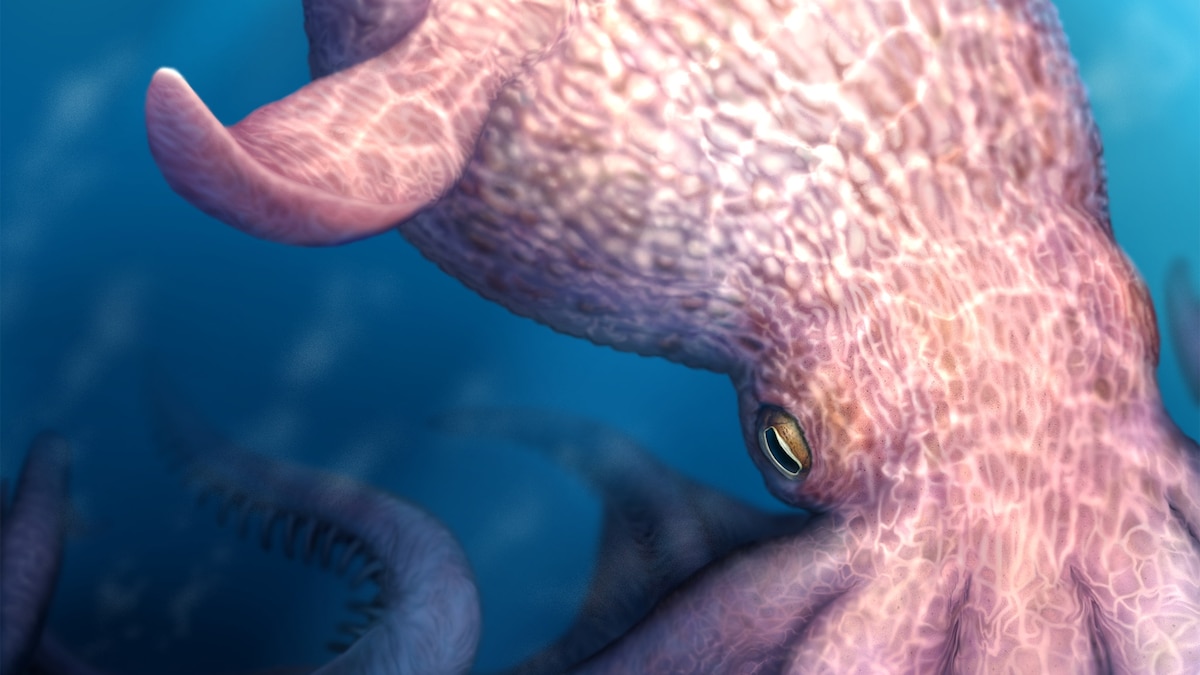
Prehistoric Giant Octopus Emerges from Fossil Record, Rekindling Kraken Legends
The deep waters of scientific discovery have once again brought forth a creature of legend, or at least something remarkably close to it. Recent findings have reignited public fascination with the idea of a "giant octopus," not in today's oceans, but millions of years in the past. Specifically, evidence unearthed from the Cretaceous period suggests that a colossal cephalopod, estimated to be around 60 feet long, once roamed the ancient seas – a creature so immense it has been likened to the mythical Kraken.
What Happened? The Discovery of a Cretaceous Colossus
The trending topic of a "giant octopus" is primarily driven by new interpretations of fossil evidence, particularly jaw structures, unearthed from the late Cretaceous period. These fossils belong to a newly identified species that scientists believe was a true behemoth. While direct fossilized remains of the entire creature are rare, the size and structure of its jaws strongly indicate an octopus of unprecedented proportions. Publications like National Geographic, NPR, and The Washington Post have highlighted these findings, describing an octopus that could reach lengths of up to 60 feet, including its outstretched arms. This makes it one of the largest cephalopods ever to have existed, far surpassing any octopus species found alive today.
Why Does This Matter? Understanding Ancient Marine Ecosystems and Evolution
The existence of such a massive predator has significant implications for our understanding of ancient marine ecosystems. A 60-foot octopus would have been an apex predator, capable of preying on large marine reptiles and fish. Its presence would have shaped the food web and the behavior of other marine life during its time. Furthermore, this discovery provides crucial insights into the evolutionary potential of cephalopods. It demonstrates that these invertebrates are capable of evolving to truly gargantuan sizes under the right environmental conditions. The comparison to the Kraken taps into our cultural fascination with monstrous sea creatures, but the scientific reality is equally, if not more, astonishing. It showcases the incredible biodiversity that once existed and the ongoing process of scientific discovery that continues to rewrite our understanding of prehistoric life.
Background Context: The World of the Cretaceous Seas
The late Cretaceous period, roughly 100 to 66 million years ago, was a time of dramatic change in Earth's history. Dinosaurs still dominated the land, while the oceans teemed with a diverse array of life, including large marine reptiles like mosasaurs and plesiosaurs, as well as various fish and invertebrates. The oceans were generally warmer than today, and sea levels were higher. It was within this dynamic environment that giant marine creatures, including this newly identified colossal octopus, could thrive. Cephalopods, with their intelligence and predatory prowess, have a long evolutionary history, and this discovery suggests a period where they reached their peak in terms of sheer size.
The Science Behind the Size: Fossil Evidence and Interpretation
Scientists reconstruct the size of extinct animals using various methods, including the analysis of fossilized bones, teeth, and, in this case, jaw structures. The specific fossils found, likely from the beak apparatus of the octopus, are exceptionally large. By comparing these to the beaks of modern octopuses and giant squids, researchers can extrapolate the overall size of the creature. The findings suggest a creature with a mantle (body) length that would have been substantial, with tentacles extending outward to create a massive diameter. While the exact diet and hunting behaviors are speculative, its size indicates it was a formidable predator capable of taking down significant prey.
The discovery of this "real-life Kraken" reminds us that the ancient oceans held wonders and terrors far beyond our current imagination.
What to Expect Next: Further Research and Public Fascination
The discovery of this giant Cretaceous octopus is likely just the beginning. Scientists will continue to search for more fossil evidence that could shed further light on its anatomy, lifestyle, and the extent of its distribution. Further analysis of the existing fossils may reveal more about its diet and its place in the Cretaceous food web. In the meantime, the public's imagination has been captured. The "giant octopus" trend reflects a deep-seated human curiosity about the unknown, both in the present and in the distant past. Expect more discussions and popular media exploring the possibilities of these ancient marine giants, blending scientific findings with the enduring allure of mythical sea monsters.
The Legacy of Giants
This prehistoric octopus joins a pantheon of recently uncovered ancient giants, from colossal dinosaurs to massive prehistoric sharks. Each discovery underscores the dynamic history of life on Earth and the vastness of what we have yet to learn. The story of this 60-foot octopus is a testament to the power of scientific inquiry to unearth the extraordinary, transforming our perception of the planet's past inhabitants and the incredible evolutionary journeys they undertook.